Regression testing where AI agents are the testers
Soundcheck
An open-source Claude Code plugin that hands plain-English test specs to AI agents on real Android emulators, iOS simulators and Chrome, has a second agent check every claim, and turns the run into one report you can act on.
Highlights
Specs that read like a test plan
No selectors, page objects or waits, so they keep working when screens are redesigned.
Nothing on one agent's say-so
A coordinator reviews every failure or doubt as it lands, and can uphold it, have it reproduced or send it back.
Runs unattended
A Rust server keeps all state in an append-only journal, so a run survives restarts.
Fast native drivers
Persistent reader apps on Android and the iOS Simulator read the screen and inject input in milliseconds.
Proven on Solo Scores
Has gated every release since v2.17.0, growing to 268 checks and finding real bugs along the way.
Why I built it
End-to-end tests for mobile apps are slow to write and break whenever a screen changes. I wanted regression testing that reads like the test plan a QA engineer would write, and that tests the app the way a person uses it.
How it works
A spec is one Markdown file: what the user does, and the outcomes to judge.
---
title: Check items off with no connection
platforms: [android, ios]
tools: [offline]
---

## Goal

Take the app offline, check off `Eggs` and `Oat milk`, then bring it back online.

## Outcomes

- Offline, the items check off as usual.
- Back online, they stay checked, and a second device sees them checked.
When a run starts, a coordinator agent (Claude) dispatches one tester agent per spec. Each tester drives a real device through Soundcheck's tools (see, tap, fill, swipe, offline, network-drop and more). It reads the screen the way a screen reader does, so an unlabelled control shows up as a finding rather than a flaky test.
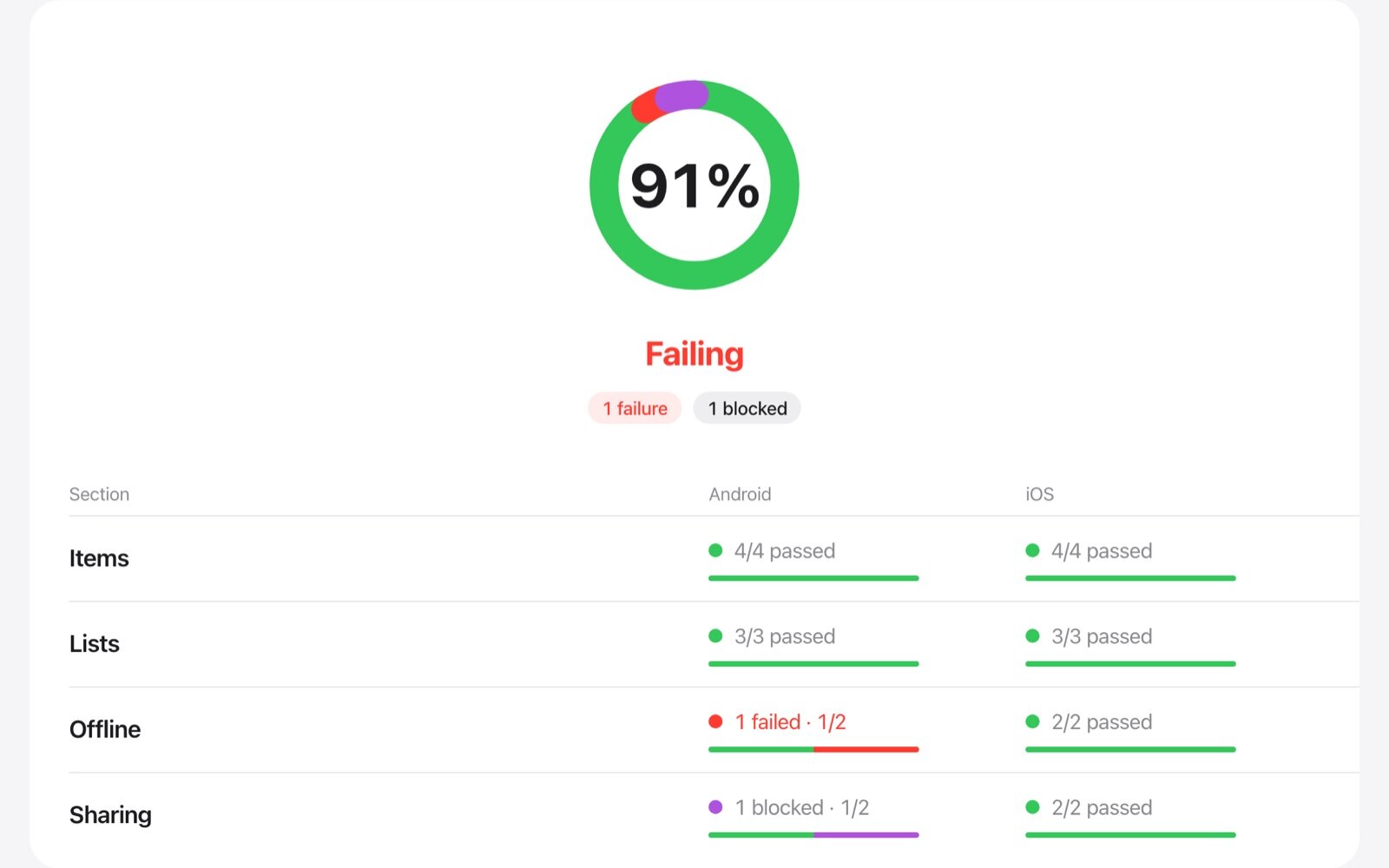
The coordinator reviews each claim as it lands. It can uphold a failure, have it reproduced on a fresh attempt, send it back, or put it down to the test harness. At the end it goes through the problems with you one at a time, and the verdict is Ready only when nothing is left open.
Under the hood
- Server (Rust: Tokio, Axum): keeps every run in an append-only journal, serves MCP over local HTTP for the agents, and hosts the live page and reports. Nothing lives only in an agent's memory, so a run carries on after a restart.
- Drivers: persistent reader apps on Android (Java) and the iOS Simulator (Swift) read the screen and inject input in milliseconds; Chrome is driven over the DevTools protocol.
- Isolation: hooks start a blank backend for each platform, and a per-platform proxy lets specs take the app offline or inject faults.
- Distribution: installed as a Claude Code plugin, with skills to set a project up, write specs and run a suite.
In use
Soundcheck has gated every Solo Scores release since v2.17.0, with the suite growing from 183 to 268 checks across iOS, Android and web. Its testers found a stuck-upload bug and missing file states, which led to reworked status icons and an upload tray that shows whether each file is waiting, uploading or failed.
Details
- Type
- Open source
- Role
- Creator and maintainer
- When
- 2026 – present
- Platforms
- Android, iOS, Web (Chrome)
- Built with
- Rust, Tokio, Axum, MCP, Claude Code plugin, Multi-agent workflows, Java, Swift, Chrome DevTools Protocol